Showing posts with label Thomas Dimmick. Show all posts

Friday, 17 October 2025

Rosencrantz and Guildenstern Are Dead - GRADS Theatre Company (9 October 2025)

Where to begin? Let's start with the sheer audacity of what playwright Tom Stoppard has accomplished. He's taken two minor characters from one of the most celebrated works of all time whose fates have been predetermined by no less than William Shakespeare, and put them front and centre in the story of their own demise. That it is witty, poignant, thought provoking, and the ending more than a little heart-breaking, is testament to the superb writing. Stoppard's love of language is instantly apparent as is his playfulness on so many levels as the duo bicker, play games, procrastinate and philosophise, unsure how to proceed after being summoned by the king. You see, there's this guy who's been moping around called Hamlet and, well, our heroes are tasked to ascertain what afflicts him. 

This wonderful premise allows Stoppard to riff on all manner of subjects from the nature of fate to the profession of acting itself. This is metatheatre writ large with a play within a play within a play that inverts Hamlet by relegating its key characters to bit players, recontextualises many of that play's key moments, and explores in more detail how the ill-fated duo come to such an ending as the title doth suggest. Oh, and there's this - it's smart and really funny. There are elements of madcap humour reminiscent of that great wave of British comedians from the sixties and early seventies (the play was first staged in 1966) who would become household names such as the Pythons. Some scenes are constructed as elaborate skits and there is plenty of physical comedy, in-jokes, mime, and sight gags. 


A play this layered and complex with rapid fire dialogue (and plenty of it), deft comic timing, and physical antics demands a lot from its two lead actors. I'm happy to announce that Alex Comstock as Guil... um... Rosencrantz, and Thomas Dimmick (Rosen... *ahem* ... Guildenstern) are more than up to the task. It's an impressive turn by both of them, immediately establishing a rhythm and genuine connection during the famous opening scene where the outcome of the repeated flip of a coin takes on portentous meaning... or not, depending on your point of view. 

Comstock's Rosencrantz is initially full of almost boyish enthusiasm and naivety which plays well against Dimmick's more assertive and thoughtful Guildenstern. There are times when this is flipped to great effect as their predicament deepens. Comstock mimics and cavorts with glee while Dimmick prowls and grimaces in existential dread. They deliver the banter dialogue with precision while luxuriating in beats where the pause, as counterpoint, is expertly deployed. They are also fabulously attired in Merri Ford's Elizabethan styled costumes with Dimmick echoing Joseph Fiennes' look from Shakespeare In Love (co-written by one T. Stoppard). The third act is particularly affecting as greater forces intervene with both actors communicating the exasperation and confusion over how it could all go so cruelly wrong for these affable courtiers.


Around our title characters swirl two sets of notable contingents - the Court from Hamlet including the prince (Leigh Fitzpatrick) who mouths the famous soliloquy, stage right, which is such a wonderfully subversive beat; and poor old Polonius (Neale Paterson) who amusingly gets wheeled out in a barrow holding a shovel after he's despatched; and the Tragedians under the lead of The Player (Jeff Watkins) who foreshadow events and provide meta commentary through acted scenes from a play... within a play... which is within another... ... play.  It's all glorious fun. Watkins brings the swagger and imbues The Player with vanity and insight while the Tragedians are a delight. Superb face makeup by Yvette Wetherilt and striking costuming by Ford, along with the vaudeville style antics of  Codey Finlay, Jordan D’Arcy, Daniel Suttner, Alex Ketko, and Tom Tasovac as Alfred, provide many memorable interactions. They work well as a company of players playing a... company of pla-- okay, you get it... with each having a highlight in portraying over-the-top deaths or heightened emotion. 

I was quite taken by the lighting design of Fiona Reid, notably in the third act when we're at sea on a boat at night. Wonderfully lit and atmospheric as the mood is contemplative and a key deception is revealed. There are also moments, earlier, when the whole stage is brightly illuminated as if there is a literal spotlight on the central characters.

I loved the back-and-forth dialogue, circular arguments, and japery but just as important is the use of silence as we empathise with the characters or feel their uncertainty. Director Tony Petani and co-director Emily Keys also aren't afraid to slow things down and take advantage of the large performance space of the New Fortune Theatre. Characters traverse the stage like chess pieces, unhurried and deliberate. As the duos' dilemma deepens though the action becomes more frantic and theatrical. 

This is an excellent production of a notable play that mirrors one of the most famous plays of all time. There truly are no small roles, only two minor characters thrust into the spotlight where the periphery becomes centre stage and the toss of a coin is something more than random chance. It's funny, provocative, and a pure delight to watch exceptional writing executed with such flair and attention to detail in all departments.  

Monday, 16 September 2024

God of Carnage - Melville Theatre Company (15 September 2024)

Two sets of parents sit on either side of a lounge room. The topic of discussion? One child has hit another child with a stick dislodging two teeth. A serious matter requiring mediation. My mind wanders to similar scenarios such as The Slap where this sort of confrontation is fraught with emotion and conflict. Then something interesting happens almost immediately. This play isn't what I'm expecting; oh no, not at all. 

This is where we need to stop and talk about great writing. French writer, Yasmina Reza, knows what those expectations are and immediately sets about subverting them. It's as if she has decided to choose the exact opposite of every beat in the familiar trajectory of this type of story. It's clever, it's intriguing, and is an absolute boon for the actors and director who get to play against type in varying ways. It's also a joy for the audience as they pick up on the sly humour and mischief of it all. 


There's a use of language that entices with oddly constructed phrases and formal words that seem out of kilter with the setting and these characters. The unseen children are talked about as if they're adults and the parents slowly devolve into the antics of children as the play progresses. There are bouts of inspired lunacy as things become more frantic. Alliances form, break apart, and reform in surprising ways amongst the four characters. 

The writing is deliciously playful and smart in its subversion of expected tropes. The ultimate aim is to explore the fault lines in two marriages and chart their demise with a healthy dose of glee and black comedy. In short, I loved Reza's script. 

My curiosity is piqued from the get go. It was all so polite in the opening conversations. Characters were agreeing to certain statements instead of arguing. It felt like a comedy of manners. Things begin to slowly shift until a spectacular comic act makes it clear to any audience members who haven't picked up on the tone what's transpiring. I won't spoil it here but it had me squirming in the best possible way! Indeed, the movement of the play through its crisp 80 minutes with no intermission is best experienced without foreknowledge. 


The writing also allows for this - a fixed set and four characters only. No need for transitions to slow things down. Even when characters want to leave, the script finds ways to keep them trapped in this room. Director Thomas Dimmick has clearly given his cast license to play and play they do with the stage manager, James Gant, having quite the clean up job after the show ends. Again, I love this sort of messiness as it comes from the actors being free to embrace the absurdity of it all. There's a fascinating dance happening as the blocking reflects the shift in character dynamics and interactions.

Dimmick's set is well appointed with sumptuous lounge chairs and lounge, a wine rack built into a cabinet, a coffee table that will weather any form of precipitation, and ceremonial African face masks mounted and lit (Clare Talbot) on the rear wall. Costumes by Michelle Sharp reinforce the differing status of every character in relation to each other and how they see themselves. 


The actors rise to the material and you can sense their joy at sinking their teeth into such well written fare. Brian O'Donovan plays what at first appears to be the everyman father who sells domestic supplies and has a dislike for rodents. His Irish accent and cheeky laugh make for a genial portrayal of a guy who simply wants everybody to get along... until we scratch beneath the surface. Taneeka Grant is the serious minded writer who goes from being passive-aggressive to openly hostile to unhinged as the aggrieved mother who's horrified at what's happened and her husband's attitude towards it. 


Patrick Derrig is the high flying lawyer glued to his bluetooth as calls periodically come in. His matter-of-fact nature and greater concern for a possible class action lawsuit eventually rubs everyone up the wrong way... including, amusingly, some audience members who audibly cringed every time his mobile vibrated with another call. Ruhama Rowe leads the fightback in defending her son while excelling in outbursts of physical comedy that caught me off-guard which made them even more potent. At one point a bottle of rum is added to the equation which only exacerbates the inherent grievances and misgivings each character has towards the others. 

I really enjoyed this. Beautifully written, wonderfully acted, and smartly directed. It was a smallish crowd for the Sunday evening show, however, I expect positive word of mouth will drive those numbers up as this is a real gem. 

God of Carnage is on at Melville Theatre until 28 September.

Photos by David Cox

Thursday, 7 December 2023

Othello - The Graduate Dramatic Society (6 December 2023)

William Shakespeare is celebrated for the sheer number of phrases and idioms he contributed to the English language, many of them still in common usage. One of the most memorable is "green-eyed monster" from Othello which is a more striking depiction of his "green-eyed jealousy" from The Merchant of Venice almost a decade earlier. That monstrous form of jealousy ripples throughout Othello, ending in tragedy for all it ensnares. The play also gives us "I will wear my heart upon my sleeve" as Iago seemingly confesses his treachery. 

And what treachery it is as Iago conspires to bring low his military commander, the Moorish general Othello, by stoking the flames of irrational jealousy over the supposed misdeeds of Othello's wife, Desdemona. Misdeeds Iago has carefully constructed through cunning deceptions and the ownership of a handkerchief - an inelegant plot device but one that features heavily. It is, as one audience member exclaimed, "very Shakespeare... everyone dies in the end." Not quite true though also not a "spoiler" for it is, indeed, a Shakespearean tragedy so blood will inevitably be spilled. 

All this under the stars on a beautiful summer's night at UWA's New Fortune Theatre, a reconstruction of the Elizabethan era Fortune Theatre where The Bard's plays were originally performed. Of course, there is the added bonus of being serenaded by the resident peacocks who display prodigious projection skills though questionable dramatic timing. It also means that the elevated stage is wide and deep with nary a place to hide for the performers with no sets and only those glorious words under the lights and gaze of audience and peafowl alike.    

Director Thomas Dimmick has made many key choices in his adaptation of the play. Several traditionally male characters - notably Cassio, Roderigo, and Brabantio - are played by Krysia Wiechecki, Tarryn McGrath, and Meredith Hunter respectively. It adds an interesting spin to the power dynamics throughout the play with subtle shifts in perspective such as it now being a mother's scorn and concern for her daughter as Hunter's Brabantio condemns Desdemona's marriage to Othello. There still lingers a distasteful sense that her objections, and the treatment of Othello in general, are because he is a Moor who therefore could only have beguiled the senator's pristine daughter with magic.  

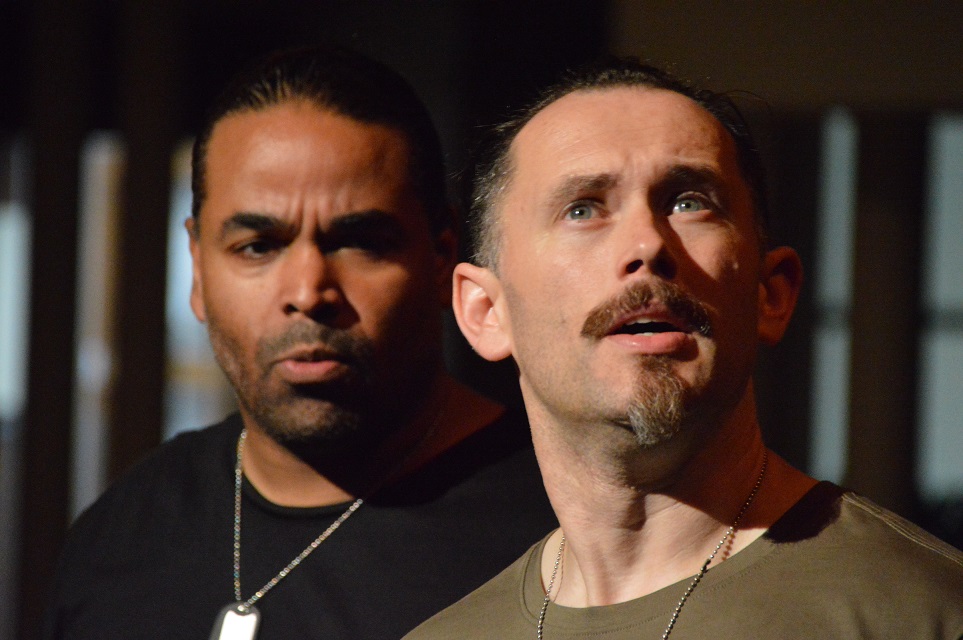
Dimmick also uses modern costuming and props - the military "men" are dressed in camouflage pants, army boots, olive green t-shirts and dog tags; the civilians in dresses, suits, or jeans. Then there's Patrick Downes' Clown who is a mixture of both styles coming across as a larrikin Cockie who happens to have stumbled into a Shakespeare production which adds well-timed and executed levity. Costume Design by Merri Ford.

The only significant set design as such is the introduction of the marital bed late in the second half where monstrous deeds shall be committed. The upstairs balcony is used judiciously when those 'on high' address their subordinates. Otherwise, sound design of battle and hubbub adds to the sense of scope; anachronistic music choices to the sense of revelry; with effective lighting design that casts our skulking villains in shadow when required and highlights touching scenes such as Emilia braiding Desdemona's hair whilst discussing marital infidelity. Lighting Design by Fiona Reed.

The play is propelled by an excellent performance from Tadhg Lawrence as Iago, the duplicitous ensign who "hates the Moor" for promoting Cassio over him. Though, it should be said, Iago's true motivations are somewhat slippery as he seems to have various grievances, real or imagined, against many of the other characters. This makes him fascinating and his schemes even more heinous. Lawrence plays him with great energy, cunning, and an affability that was disarming as he addressed the audience. I loved the confidence of his eye contact in those moments and while the standing order appeared to be "if a peacock squawks, wait" Lawrence would often use his own excellent projection to contest said fowl. 

Erik Bibaeff certainly brings a physical stature to Othello and there's no doubt there is a sense of brooding menace in the second half. However, I found him a little stiff and one note as the titular character, mainly relying on an increase in volume to denote anger and telegraphing his emotions rather than convincingly conveying them to us and the other characters. There is a gasp-worthy burst of violence that he handles well and the physical threat to Desdemona is clearly established.  

Krysia Wiechecki gives a lively performance as Cassio before expertly recalibrating after the Vodka-induced fight with Montano (Jarrod Buttery), another of Iago's schemes. This sees Cassio fall foul of Othello's good graces and Wiechecki brings a keen sense of the import of such a loss of reputation. 

The program announces this is Anna Weir's first community theatre production which makes her portrayal of Desdemona even more remarkable. She lent such decency to the woman who is beset by innuendo and doubt while unfairly pilloried as a 'whore' and 'strumpet' for totally fabricated infidelities. One unpalatable conclusion is that Desdemona is being punished for having the audacity to marry a Moor. Weir brings a sweetness and dismay that heightens the impact of Desdemona's fate.   

Tarryn McGrath also enacts a clear action change as her Roderigo morphs from a hapless pawn of Iago's scheming to reluctant participant whose sense of unease and demise is perhaps more poignant now. Downe's adds jocularity and easy charm with an Aussie flavour; Hunter is relentless as the aggrieved mother early on in the play; and Grant Malcolm brings a crisp authority to Lodovico in the second half.  

Then there's Grace Edwards whose Emilia, Iago's wife, emerges in the second half as a force to reckon with. Faithful to Desdemona as her maidservant and loyal to her husband, Emilia comes to learn of her unwitting part in Iago's scheme as the ramifications careen towards a bloody conclusion. For all the talk of 'honesty' in the play, it's Edwards who imbues Emilia with the most honest reaction to the outrages that have occurred and those to come. The rage she summons at both Othello and Iago is justified and utterly compelling. For mine, Desdemona and Emilia are the two most tragic figures, unfairly caught up in the petty machinations of men. I was unmoved by Othello's ultimate fate as, even though he was manipulated, his response is so massively over-the-top and abhorrent that I have no pity for him whatsoever. But that's one of those wonderful gifts of a Shakespeare play - the discussions afterwards.

This is a great opportunity to see a classic tragedy at a wonderful venue where much care and attention has been taken by the cast, crew and creatives. There are five more performances on 8, 9, 14, 15, 16 December at the New Fortune Theatre in the Arts Building at UWA.

Photos by Grant Malcolm.