Showing posts with label Adam Booth. Show all posts

Thursday, 4 August 2016

The Caucasian Chalk Circle - Black Swan State Theatre Company with The National Theatre of China (1 August 2016)

During a time of rebellion a servant girl rescues the baby of the deposed Governor and flees into the mountains leaving behind her beloved, a soldier off to fight in the ensuing war. She eventually reaches her brother’s farm and safety where she raises the baby as her own, now trapped in a marriage of (in)convenience. Two years later and they are discovered with the Governor’s wife demanding that the baby be returned. A trial is convened presided over by Azdak, a man elevated to the lofty position of judge in the most unusual of circumstances. He devises an unexpected method by which to decide custody of the child.    

This sumptuously visual and aurally rich production is the first international collaboration for Black Swan in conjunction with The National Theatre of China. Written by German playwright Bertolt Brecht, directed by Dr Wang Xiaoying, and featuring an Australian ensemble it is a fascinating mixture of storytelling styles and culture. Exquisite costumes (Zhao Yan) and masks (Prof Zhang Huaxiang) are matched as a highlight by the superb accompaniment of local indigenous musicians on guitar/vocals and percussion (Dr Clint Bracknell and Arunachala). Australian accents abound including the broadest of Strine as the servant girl, Grusha (Alex Malone), encounters a variety of colourful characters along her journey.

There is a meeting of three distinctive styles – a form of Chinese theatre known as Beijing Opera; the traditional oral storytelling of indigenous Australians as embodied by Lynette Narkle, the ‘Old Woman’ who sets the scene; and the play within a play construct by Brecht as part of his ‘epic theatre’ movement.

Added to this is the inclusion of songs that inform the narrative and move it forward in impressive style. The lyrics are projected as surtitles in both English and, as I was informed by the couple sitting next to me, modern Chinese characters. The backdrops were deceptively effective – three layers of jagged curtains that when lit represented the mountains and other locations with a real sense of depth. My well informed fellow audience members also remarked how reminiscent this was of Chinese oil paintings.

As you enter the theatre, the company are warming up in their blacks which included Black Swan t-shirts! Two racks of costumes are onstage as well as a rack of masks. Lighting rigs are visible on the fringes of the performance space, indeed you could clearly see into the wings from my vantage point. A microphone is positioned stage right; the two musicians stage left. All the mechanics and devices of a theatrical production are boldly laid out in plain sight. Then something interesting happened – the normal pre-show babble died down with no discernible signal or change in status from the actors as if suddenly there was a shared expectation from the audience. The actors continued to warm up vocally and physically in a hushed arena. Then we are thrust into the tumult as the story begins...

This melange of highly distinctive styles instead of competing with each other somehow melded into, oftentimes, quite an exhilarating production. Set design (Richard Roberts) was simple and effective with two arches – one a larger traditional Chinese arch; the other a smaller bamboo construction used to signify doorways – wheeled into place by stagehands who would occasionally stay onstage briefly as observers during a scene. There was judicious use of a wooden revolve in the centre of the stage. Chairs were used to represent everything from a rickety bridge over a mountain pass to the sparse furnishings of various abodes.

To the performances and Alex Malone in her Black Swan debut was outstanding as Grusha. There was a jauntiness in her interactions with the soldier (James Sweeny) Grusha falls for; hesitation and uncertainty as the Governer’s wife (Caitlin Beresford-Ord) becomes more concerned with her wardrobe than her baby as the Ironshirts threaten; a softness with the baby Michael; and real tenacity as the character survives relentless pursuit and then asserts her claim to be the rightful mother. Malone also has a pleasant singing voice that was used to good effect sporadically throughout. Most importantly though, given the comical and over-exaggerated characters Grusha meets, it’s a totally grounded performance undertaken with great confidence.

Others to stand out – Steve Turner in a variety of roles, each given distinctive flourishes that made his presence memorable; Adam Booth especially as a lascivious Ironshirt who caused the skin crawl with some wildly inappropriate innuendo, gleefully delivered; and James Sweeny was a forthright soldier that matched Malone in crafting a realistic portrayal that worked well in moments of tenderness and in disappointment when his Simon discovers Grusha is married. Beresford-Ord made for a regal and disdainful Governor’s wife while Luke Hewitt was given characters most often flirting with caricature, deploying almost Barry Humphries style vocal emphasis at times.

Then there’s Geoff Kelso whose Azdak takes over as the focal point in the second half. He stumbled over his lines a few times during the second preview which will no doubt iron itself out but his judge is an archetypal Aussie larrikin that would be right at home in something like The Castle.  

The icing on this theatrical layer cake is the musical accompaniment. Bracknell has an earthy voice that was a perfect fit for the songs creating an enormous amount of atmosphere. His guitar playing was excellent and the percussion by Arunachala was equally evocative or menacing as required. There is a superbly crafted turning point that is enhanced by song and performance when Grusha makes the fateful decision to take the baby. It’s a wonderful synthesis of all the theatrical elements in this show’s formidable arsenal.

There were a couple of things that jarred – the number of cases Azdak hears after his appointment was perhaps one too many in establishing his unique bona fides; and some of the more exaggerated Australian accents were too incongruous even in the context of the artifices established.

The overall impression though is one of appreciation and admiration for this unique staging of Brecht’s masterpiece.

The Caucasian Chalk Circle is on at the State Theatre Centre until 14 August.

*Photos by Philip Gostelow except the masks photo courtesy of James Sweeny

Wednesday, 1 June 2016

Angels in America, Part 1: Millennium Approaches - Black Swan State Theatre Company (30 May 2016)

There are many things other than angels hovering over Tony Kushner’s generally recognised modern master work – Reagan’s America, the impending turn of the century, fear and prejudice as the AIDS virus takes hold, a sense of mortality as we are buffeted by politics, religion, disease, and our own weaknesses. It is gloriously theatrical, brutal, funny, confronting, compassionate, but above all else human. It deals with the inner turmoil of failing to cope with a loved one who is dying under terrible circumstances or mentally decaying before your eyes; the denial of one’s own sexuality through either expediency or guilt; the yearning for connection and love even in the most terrible of circumstances. Within those dilemmas and human interactions is a precise sense of time and place. The coming end of the millennium is truly an earth shattering event.

Black Swan’s production is a finely acted and stylish piece of theatre that befits the rightly lauded writing. The first half of this preview flew by in a dazzling 90 minutes. The second half gets a little funky as the hallucinations and visitations become bolder until it all ends in a crescendo that has you wishing Part Two was but a dinner break away.

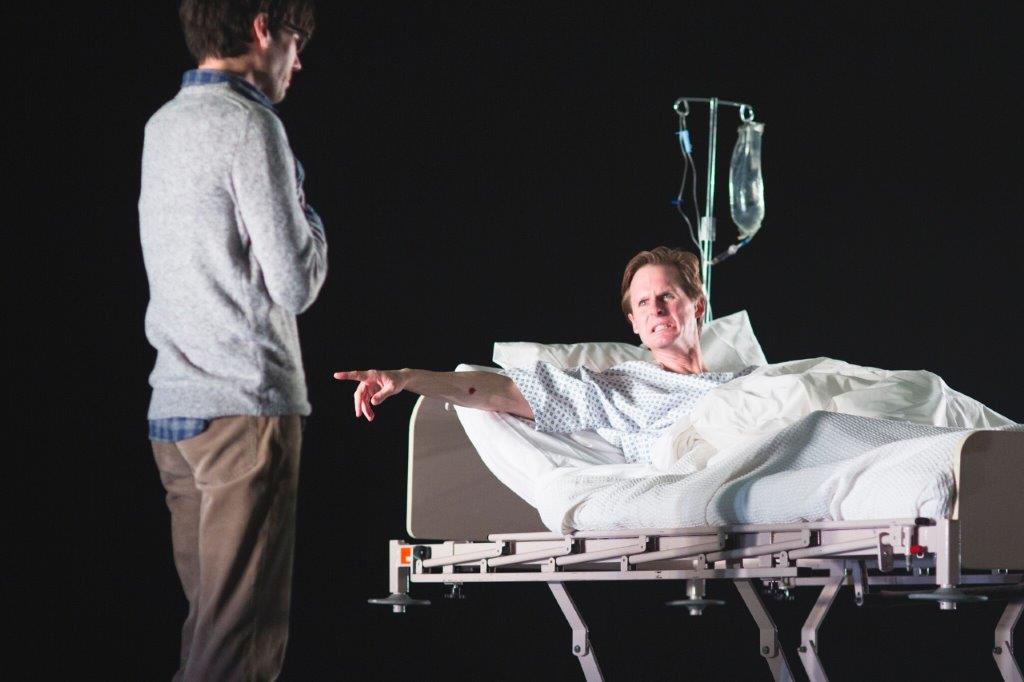
The stage is flanked by impressive lighting rigs that are utilised in style by lighting designer Matt Scott from the stark whiteness of Antarctica to night time interludes in Central Park to the announcement of a divine messenger. There is judicious use of music by Ash Gibson Greig including a gorgeous version of Moon River on only violin and piano in a moment that is both joyous and heartbreaking as AIDS ravaged Prior Walter (Adam Booth) dances with his estranged lover Louis Ironson (Will O’Mahony).   

The set takes full advantage of the technical wizardry available at the Heath Ledger Theatre. Director Kate Cherry and Set Designer Christina Smith have wisely gone for a minimalist look with settings represented only by a key piece of furniture – Ray Cohn’s desk, a wash basin, a settee, a hospital bed etc that all effortlessly glide into place. The transitions are slick and the focus is on the performances and Kushner’s prose that is, at turns, poetic, cruel, dagger sharp or slyly funny. And make no mistake there is great humour to be found here amongst the emotional tumult. The climactic ending summons the full arsenal of lighting, sound, costuming, and set design as the world literally falls in on Prior.

The standout performance of the first half belongs to Jo Morris who plays Harper, a woman struggling to deal with her own demons including fear of climate change and the strange noises coming from the bedroom. Reliant on Valium, Harper conjures imaginary friends and hallucinations with a self-awareness that is funny but laced with poignancy. Morris displays wonderful comic timing especially in the hallucination sequences which she tackles with relish. But the irrational fears and reliance on pills are given harrowing treatment as well. The second half suffers a little from her lessened presence except for the bravura Antarctica sequence that is a highlight for Morris.

The other standouts are Adam Booth as Prior who gives an emotionally truthful performance as a man not only dying from AIDS but devastated at Louis’ withdrawal; and O’Mahony as Louis who has a complex arc as he seeks solace in his ‘betrayal’ by engaging in acts of cold, random sex while striking up an unlikely friendship with Harper’s husband Joseph Porter Pitt (Stuart Halusz). Joe has denied his sexuality until finally confessing he is a homosexual over the phone to his mother in an all too real awkward moment of self-loathing and revelation. Prior and Louis coming to terms with their relationship and Prior’s imminent death is the backbone of the second half with Booth and O'Mahony compelling.

John Stanton plays the loathsome lawyer and power broker Ray Cohn with expletive laden relish but it’s in the quieter moments where he excels – the scene with Joe at a bar and his confrontation with a ghost from the past are memorable. The rationalisation Cohn gives on learning of his medical condition is delivered with chilling pragmatism by Stanton – status and power are the only language the character understands and deals in. Halusz in many ways has the trickiest role as his Joe is an earnest character who denies his true self and remains principled in the face of Cohn’s temptations and his wife’s descent into fantasy. He plays the Mormon lawyer with a straight forwardness that works in contrast to the showier roles around him and acts as a foundation of sorts for the audience.

The only weakness is Kenneth Ransom’s dual roles of Harper’s imaginary friend Mr Lies and the gay drag queen Belize. The latter simply isn’t flamboyant enough and the former lacks any flair. Both are opportunities to ‘go large’ but ended up being flat portrayals barely differentiated from each other. Felicity Mckay and Toni Scanlon round out the cast with Scanlon especially engaging as the Rabbi.

I enjoyed the superb first half more than the second which had some odd scenes that seemed somewhat extraneous (largely revolving around Joe’s mother coming to New York) or verging into Pythonesque territory (Prior’s ancestors visiting his sick bed). Otherwise this was an excellent production that showcased Black Swan’s considerable technical and performance capabilities.

Written by Tony Kushner, Directed by Kate Cherry and starring Adam Booth, Stuart Halusz, Felicity Mckay, Jo Morris, Will O’Mahony, Kenneth Ransom, Toni Scanlon, and John Stanton, Angels in America, Part One is on at the Heath Ledger Theatre until 19 June.   

*photos by Daniel James Grant

Tuesday, 21 July 2015

Blithe Spirit - Black Swan State Theatre Company (20 July 2015)

There was ectoplasmic presence a plenty at the second preview of Noel Coward’s astral comedy Blithe Spirit. Director Jeffrey Jay Fowler promised us a once in a lifetime experience as he peeked out from behind the sumptuous red curtain to inform us that Madame Arcati as played by Roz Hammond had been struck ill. He was proven correct in many ways. Alison van Reeken after only one read through of the script and one rehearsal all but stole the show giving a wonderfully physical performance as the clairvoyant even with script in hand.

Normally those three words – script in hand – send a shudder down the spine but here it was as impressive a feat of acting as you’ll see given the circumstances. Afterwards Fowler admitted it was quite a different interpretation of the character but for me it gave the show a jolt of unpredictability as the other actors reacted to van Reeken’s spontaneous and oft hilarious antics.

The set was superbly appointed with the Condomine home well represented with portraits, period furniture, gramophone, and large French doors, stage left. It also revealed some cleverly executed secrets later in the play to great effect. At first though the cavernous space posed somewhat of a problem with plenty of echo and a lot of the opening dialogue faint and a little indistinct. The projection improved certainly with the introduction of van Reeken and Michael Loney (Dr. Bradman) but eventually across the board as all the actors warmed to the task.

It was a bit of a tentative start but the play really found a rhythm in the scene between Charles (Adam Booth) and Ruth Condomine (Adriane Daff) the morning after the séance that summons Charles’ dead first wife Elvira (Jo Morris). The rat-a-tat-tat dialogue as the two exchange arch comments based on Ruth’s misunderstanding of her husband’s retorts to the ghostly Elvira ups the energy and pacing dramatically. There is a similar exchange in the second half between Charles and Elvira that equally pops and fizzes with wonderfully written and delivered verbal venom and dexterity.
Booth, Hetherington & Daff - Gary Marsh Photography

Booth was very good as the writer who initially is only interested in researching jargon for his latest novel, never inclined to believe Madame Arcati’s talents. His arc from disbelief to concern about his mental state on seeing Elvira to embracing and then enjoying the fun and games of the situation to finally exasperation and alarm was well calibrated. Morris plays Elvira with an almost childish glee and impetuousness as she beguiles Charles and infuriates Ruth. Dressed entirely in white with deathly pale makeup and powdered white hair she is a restless spirit as she glides around the stage barefoot.

Daff’s Ruth was very formal, rigid and quite glacial and she was at her best when allowing the character’s urbane façade to slip as frustration and bitchiness emerged. It was a performance that only became stronger the longer the play went. Ella Hetherington (Edith) committed to her character’s running gag that was quite literally a running gag until the maid takes on much greater significance in the second half. Loney and Michelle Fornasier (Mrs. Bradman) lent good support with their own running gag over the doctor’s reluctant refusal of various nightcaps.

Fornasier, Booth, Daff & Loney -
Gary Marsh Photography
The lighting design by Jon Buswell, especially in representing different times of day, was very good and Ash Gibson Greig provided fun and creepy musical interludes as the curtains were closed as the stage was reset between scenes.

It is quite a long play and the second half was much tighter than the first but that should shake out over the run and as van Reeken is integrated into the cast after a hugely impressive last minute debut. 

Written by Noel Coward and Directed by Jeffrey Jay Fowler, Blithe Spirit stars Adam Booth, Adriane Daff, Michelle Fornasier, Alison Van Reeken, Ella Hetherington, Michael Loney and Jo Morris and is on at the Heath Ledger Theatre until 9 August.  

Friday, 16 January 2015

Venus in Fur - Black Swan State Theatre Company (15 January 2015)

Power. Control. Domination. Subjugation. Mistress. Slave. Goddess. Mortal. Director. Actress. Ambivalent. Ambiguous. Explicable. Extricable. A potent stew of taboos and desires mixed with a healthy serving of word play, sly humour, and top notch performances.

Who really is in control – the one who dominates or the one who craves domination thus seeking to set the terms of the relationship? How easily can those lines be blurred? In real life, in fiction, in the creative process? How easily can they be reversed?

Venus in Fur is a wonderfully layered ‘play within a play’ that seeks to explore these issues under the tantalising banner of sex and masochism. But that’s only the pretext for 90 minutes of sparring between two actors who inhabit multiple roles and changing perspective as the balance of power shifts and mutates in riveting fashion.

A playwright/director, Thomas (Adam Booth), is at the end of a fruitless day auditioning actresses for his latest play based on an 1870s masochistic novel. In storms an actress, Vanda (Felicity McKay), hours late, who coincidentally has the same first name as the character in the adaptation. Seemingly coarse and unsuitable she convinces Thomas to allow her to audition with a level of preparation and insight that intrigues and impresses him. As they read scenes together his play comes to life in ways Thomas never bargained for. Indeed, Vanda proves adept at taking control of not only the creative process but Thomas’ own latent desires.

Booth is good as Thomas – from frustrated director to eager supplicant, he is challenged by Vanda the actress and Vanda the character of his adaptation with even the goddess Aphrodite making an appearance. There is an earnestness and belief in Booth’s portrayal that acts as the bedrock for the assault to come - on Thomas’ motives for adapting the play, to his interpretation of its meaning and, ultimately, who and what he really is. Highlights come in an early monologue from the play reading where the fascination with fur (and pain through submission) is revealed – a Countess Aunt who beat the character with a birch switch while he was prone on her fur coat. 

Booth also has a well-judged outburst where he turns verbally nasty after Vanda pushes him too far and he tries to reassert control as snarling director over the ‘stupid actress’. Then there is a sense of eagerness and desperation as the character plummets further down the rabbit hole and begs to subjugate his very identity to be nothing more than property. The scene where Thomas is commanded to change Vanda’s footwear to knee-high boots is languid sensuality and desire writ large.

Felicity McKay is simply outstanding as Vanda. Her accent work is excellent and she slides in and out of various characters with astonishing ease, each one of them utterly distinctive so there is no prospect of confusion. She runs the gamut from playful, sexy, sensuous, commanding, dismissive, brash and refined but always with an underlying air of intrigue about who this person really is. There are explanations given that seem plausible enough but still left me in doubt as to their veracity. It’s the far showier part but handled superbly in McKay’s professional debut. Above all, the sense of playfulness here is a joy to watch as is a compelling stage presence even when not featured in any given scene. A striking figure, especially in an array of memorable costumes, McKay is eminently watchable because she is always in the moment.

The set is quite simple with a divan the centrepiece. A storm rages “outside” (which pales in comparison to the tempest on stage) and the lighting handled this effectively. I wasn’t a fan of the incidental music that was intermittent and barely audible which made it more a distraction than an asset. Part of the ‘power struggle’ is who controls the blocking in the play within the play and there is a nice sense of movement throughout as a result. 

The writing is smart and it is genuinely funny though the humour is sometimes a little off-kilter given the context but I loved it for being as brash and unapologetic as its leading lady. There are also lots of theatre in-jokes (where is stage left again?) that amusingly bolster the creative battleground for supremacy between director and actress. The last stanza took an interesting turn as events fold in on themselves and roles are reversed but on first viewing I found that a little hard to follow. It certainly sponsors further thought and debate and this is a play that will linger with you long after the final whip crack.

Venus in Fur is a cleverly written play that allows two talented actors to inhabit multiple personas in a provocative, insightful and funny exploration of a subject matter many consider taboo. It is a great start to the theatre season and the upcoming Fringe Festival of which it’s a part.

Written by David Ives, Directed by Lawrie Cullen-Tait and starring Adam Booth and Felicity McKay, the play is at the Studio Underground in the State Theatre Centre and opens Saturday 17th January and runs until Sunday the 8th February.