Showing posts with label Heath Ledger Theatre. Show all posts

Saturday, 19 April 2025

The Diary of Anne Frank - Drew Anthony Creative (17 April 2025)

Complete quiet. Between 8am to 6pm. Every day. Day after day. For a little over two years. Talking nothing above a whisper. Unable to use the facilities. Or move about in other than stockinged feet. Lest a noise attracts unwanted attention. The sort of attention that could lead to your death. A fear and constant dread that is unfathomable. Yet amongst this horror comes an extraordinary testament written by a teenager, only thirteen when she was gifted what would become her famous diary. It's a true life tale that demands the utmost respect and care when being adapted for screen or stage.

Director Drew Anthony, up to this point best known for crowd-pleasing musicals, ventures into the world of drama for the first time well aware of the enormous responsibility he's undertaken. From the choice of the 1955 adaptation by Frances Goodrich and Albert Hackett that saw them win the Pulitzer Prize for Drama; to the staging of the production at the prestigious Heath Ledger Theatre; the attention to detail in the presentation of the set; and a committed cast wonderfully led by Chloe-Jean Vincent as Anne Frank. 


In Vincent, Anthony has found an actress who embodies the many facets of the title character - from childlike innocence, petulance, rare insight for one so young, stubbornness, a growing sexuality, and the frustrations that come with being cooped up inside for so long, mainly with adults. It's a wonderful performance that is captivating and heartbreaking. It's a role that demands subtlety and nuance as Anne has a frosty relationship with her mother Edith (Holly Easterbrook), a much closer one with her father Otto (Phil Bedworth), and various complications with the other characters including the three years older Peter Van Daan (Nathan Hampson), initially an annoyance who slowly becomes a tentative romantic interest. We also never lose sight of Anne's literary ambitions and her belief in the essential goodness of humanity, punctuated by moments of terror in harrowing nightmares. 

The other standout is Bedworth who imbues Otto Frank with a decency and stoicism that is quietly compelling. We empathise with a man desperate to keep his family and his guests, the Van Daans, safe at all costs. We understand without question why such a dignified and compassionate man would not hesitate in accepting the risk of another lodger entering the secret annex in Jan Dussel (Jamie Jewell). 

Vincent and Bedworth are surrounded by a cast of well drawn performances. Easterbrook makes for an elegant Edith Frank who laments the lack of warmth from Anne before her frustrations explode in the second half; Asha Cornelia Cluer, by contrast, is showier and increasingly fraught as Petronella Van Daan, a beloved fur coat the cause of several disputes. Matt Dyktynski portrays Putti Van Daan as a ticking time bomb of grievances that threatens any sense of fragile harmony. Ciara Taylor is quiet and reserved as Anne's older sister Margot who is beloved by all; Jewell brings a touch of theatricality as the outsider who becomes increasingly exasperated at having to share a room with Anne and is none too kind about Peter's clumsiness. Hampson navigates a tricky arc from juvenile antagonist to shy confidant and maybe something more with endearing skill; while Kingsley Judd and Grace Tolich are earnest and kind as the loyal helpers who provide food rations and news from the outside world. 

While the situation is bleak there are many moments of warmth, camaraderie, and good natured humour as we are immersed in this hermetically sealed world. Yet human foibles, unrelenting pressure, and the claustrophobic nature of their confinement lead to relationships fracturing as the tension mounts. It's an emotional rollercoaster not only for the characters but the audience as well. We are never left in any doubt as to the stakes with two swastikas, that horrid and despicable symbol of hatred, omnipresent as they hover over the set. Shocking too is the yellow Star of David with Jude inscribed in the centre which the Franks and Van Daans have been forced to wear in the outside world of 1942 Nazi occupied Amsterdam. They are quickly ripped asunder once inside the bookcase concealed refuge. 


Production Design (Drew Anthony), Scenic Build (Rosie Martin), and Scenic Artwork (Jesse Kaserer) create a sombre toned representation of the impressively realised, multi-tiered annex from the attic Peter resides in to the many other bedrooms and shared living space. Costumes (Coordinator, Annette Stivaletta) are also muted in tone and style with two notable exceptions - the aforementioned hint of ostentation with Petronella's fur coat, and, in the second half, with a seeming nod to Schindler's List, the red dress Vincent wears which is a sign of Anne's growing maturity. 

One element I did trip on was the deliberate choice not to use props other than significant items such as the diary itself. This meant there was a significant amount of miming by the actors when dealing with 'paperwork' or 'presents' in the Hanukkah sequence or the consumption of food and drink. Given the attention to detail for all the other elements such as the movie star posters Anne tapes to her bedroom wall this had a tendency to jar.

Lighting design by Christian Lovelady adds to the sense of claustrophobia and foreboding when needed with characters in darkness and shadow but also lends warmth to more positive sequences. Notably, scenes where Anne is reciting passages from her diary as she writes are bathed in a spotlight with the rest of the set concealed in darkness. Audio design by Jordan Gibbs is critical to give a sense of the tumult outside their hiding place including the changing nature of the war as air raids become an increasing reality as the Allies prepare for D-Day and blessed liberation of Europe. 

Yet there are two sounds that cut to the bone - the clatter of a fallen chair, and Petronella's frantic tirade at one point that had me cringing in horror, silently begging her to stop. Such engagement is testament to the immersive nature of the world that had been created.

Their discovery when it comes is gut-wrenching and sad because we know it's all too real what happened. The bookends of Otto returning to the annex to recover the diary are emotional and respectful as we learn of the others' fate, including Anne who died of typhus in a notorious concentration camp. This leaves the audience emotionally devastated yet buoyed by the honesty of the performances. 

As of writing, the production has finished its current run. I believe there are discussions for it to be mounted in other states with a possible return to Perth at some stage. There is no doubt this is a well-acted and moving piece of theatre that highlights the resilience of the human spirit even in the face of unspeakable barbarity. A well-timed reminder of what's worth fighting for even to this very day.

Monday, 21 August 2017

Switzerland - Black Swan State Theatre Company (21 August 2017)

An emissary from a New York publishing house (Giuseppe Rotondella) is dispatched to Switzerland to convince reclusive crime novelist Patricia Highsmith (Jenny Davis) of The Talented Mr. Ripley fame to sign a new contract.

A bold move to stage a two-hander at an hour forty five minutes with no intermission in the Heath Ledger. The massive stage space was wisely reduced with a monolithic bunker design that sloped upwards from (audience) left to right which I took to hint at the title's terrain but mainly gave a visual indication of the power dynamics at play. This was consistent early with Davis always 'above' Rotondella as befitted their comparative status (and the distance between them also seemed calculated) but that spacing lost its discipline later in the play with the first 'crossing' of less impact than one might have thought.

The decorated Davis is suitably caustic as Highsmith and newcomer Rotondella is all wayward gestures as the callow intruder into her literal bunker-like mentality. But those default positions for a play that talks about and explores, amongst other things, transformation felt too rigid for too long.

More interesting were moments of contrast - seeing Highsmith unexpectedly enjoy 'show tunes' and especially become immersed in moments of introspection. Likewise, Rotondella comes to the fore in the latter stages when his character takes on a stronger, more confident tone and the power dynamic is altered.

Those transformations needed to be sharper and the timing in only the second preview felt off. That should shake itself out over the run with the back and forth becoming crisper and the shifts more clearly delineated.

There were moments you could see where the play will really hum - the delight Davis gives Highsmith when she deduces Edward Ridgeway's background; the two of them plotting the next Ripley novel; and the interaction in the final act.

As a writer I also enjoyed observations and commentary on the process of writing and the relationship between an author and the world and characters they create.

At this stage the play didn't quite fire on all cylinders for mine but that's what previews are for and once this finds its rhythm and with the talent involved will be a tidy two-hander with an appropriate denouement.

*originally published at facebook.com/perththeatrereviews

Tuesday, 30 August 2016

Clinton The Musical - Black Swan State Theatre Company in association with Perth Theatre Trust (29 August 2016)

At the heart of Clinton the Musical is a pretty good idea. The charismatic yet deeply flawed William Jefferson Clinton is such a polarising figure in American politics that he literally inhabits two separate personalities – the consummate politician WJ Clinton (Simon Burke) and the self-destructive philanderer Billy Clinton (Matt Dyktynski). This conceit, while not excusing the more reckless aspects of his Presidency, does in fact make Clinton a surprisingly sympathetic figure. It was the other guy who did all those things!

The second surprise is that the musical seems incorrectly titled because for much of its running time it is undoubtedly Rodham-Clinton the Musical with Lisa Adam giving a terrific performance as Hillary. Adam made for a most funky First Lady who wasn’t afraid to assert herself with the boys and displayed excellent comedic chops. The sight of Hillary busting a groove in a stylish pant suit was inherently funny and the humour was self-deprecating here with all of the Democratic Presidential Nominee’s current woes revisited including a prescient call to Donald Trump. The overall result, however, is wildly uneven with some very strange choices in the construction of the Book and a largely unmemorable set of songs.

I fully expected that the Clintons would be raked over the coals and there is no doubt there are a lot of cheap and easy laughs at their expense. However, they come off lightly compared to the villains of piece. Apparently Kenneth Starr, according to the Hodge brothers, was the key architect of the plot to destroy the Clintons right from the get go like some modern day Littlefinger. I can accept that as creative shorthand to coalesce the forces of opposition into one identifiable antagonist. What I didn’t understand was Starr's portrayal as a cackling, hyper-sexualised comic book villain that would have fit right into something like Despicable Me, inexplicably. Paradoxically, Brendan Hanson, always a solid and dependable leading man, grabbed the role by the scruff of the neck and gave such a scene chewing, lascivious performance that you couldn’t take your eyes off him. Even when averting your eyes might have been wise in the gloriously camp Starr is Born.

The figure who came off worst though was Newt Gingrich who was depicted as an infantile dolt. Luke Hewitt did as much as he could with the Republican Speaker including a funny moment with a can of peaches (impeachment, geddit?) but otherwise this was another cartoon character. At one point I literally said to myself, “Oh, it’s Homer Simpson… without the goofy charm.” The most negative result of this simplicity is when Newt’s stunning hypocrisy is revealed. Yes, he was having an affair with an aide during the impeachment hearings yet I didn’t like the implied commentary about young women who ‘throw themselves’ at such men when those men are shown to be utter buffoons.

That the forces of opposition were so cartoonish was a considerable weakness. I know I have been spoiled by Aaron Sorkin’s and Lin-Manuel Miranda’s master works on American politics but there was no subtlety and rarely any cleverness here. The humour would frequently cross the line from raunchiness to simply being crass - the notorious cigar gets a good work out in some tasteless sight gags. 

Monica Lewinsky is blessedly played with some restraint by Megan Kozak and her first meeting with Clinton is quite well handled. The awestruck, naïve youngster is bedazzled by Billy. Kozak then gets the signature song you’ll probably be humming along to for days which would be fine except for the fact that the chorus is “I’m fucking the fucking President, oh yeah, oh yeah!”  (I apologise to any workmates today who may have inadvertently overhead such recounting). She belts it out in style and displays her own quirky comedic style that was showcased earlier in the year in a couple of Fringe World cabaret shows.

As for the Clintons, Burke comes into his own more in the second act and has one of the few musical highlights with A Place Called Hope where the over the top artifice is momentarily stripped away and we get the briefest glimpse of a real human being. He also has some droll fun with It Depends as Clinton indulges in verbal gymnastics in an attempt not to perjure himself. That this is immediately sabotaged by the juvenile Sexual Relations is emblematic of the production as a whole.

Leather clad Dyktynski was a strangely passive Billy and one of the flaws in the Book was the amount of times his alter ego or Hillary would exclaim, “I want you gone!” It was too much repetition for no result. Indeed, the split personality could have been utilised far more effectively if the relaxed and confident Dyktynski was given more leeway and agency. The other notable over usage was of the word ‘legacy’ which was hammered home innumerable times with ever diluted impact.

The final member of the cast, Clare Moore, most amusingly was a spunky Eleanor Roosevelt whose pronouncements were misinterpreted by Hillary. Moore also is the Judas of the piece with an over-eager Linda Tripp keen to make her mark as she betrays Monica’s confidences.    

While I have many misgivings about the content, the set was quite spectacular – a giant rotating rotunda with the band perched on the top level while underneath, on one side, was a representation of the columns of the Capital Building where Congress sits; the other the Oval Office (though that, Sir, is no Resolute Desk!). The show is directed with flair by Adam Mitchell who did briefly address the audience at the beginning of the second preview as some technical difficulties had occurred two nights before. No such problems seemed to bedevil this ‘second dress rehearsal’ and he used Hanson, Kozak, Moore, and Hewitt in a variety of supporting roles, notably as members of the press.  

What ultimately to make of Clinton the Musical then? I found it spasmodically funny but often I was laughing at it rather than going along with the gag. There are a couple of sequences where it threatened to elevate itself into something greater – Starr is Born/Lie To You in the first act and A Place Called Hope/Enough in the second. Lisa Adam was excellent and it was fun to see Hanson cut loose, albeit in a problematic role. I was also delighted to see Kozak do well in her first outing for Black Swan in what again could have been a tricky characterisation. It had its moments but in the end the second act dragged and the whole endeavour was a little too hit and miss for mine.  

Book by Paul and Michael Hodge; Music and Lyrics Paul Hodge. Directed by Adam Mitchell, Musical Director David Young and starring Lisa Adam, Simon Burke, Matt Dyktynski, Brendan Hanson, Luke Hewitt, Megan Kozak, and Clare Moore, Clinton the Musical is on at the Heath Ledger Theatre until 11 September.

Images by Daniel James Grant

Wednesday, 1 June 2016

Angels in America, Part 1: Millennium Approaches - Black Swan State Theatre Company (30 May 2016)

There are many things other than angels hovering over Tony Kushner’s generally recognised modern master work – Reagan’s America, the impending turn of the century, fear and prejudice as the AIDS virus takes hold, a sense of mortality as we are buffeted by politics, religion, disease, and our own weaknesses. It is gloriously theatrical, brutal, funny, confronting, compassionate, but above all else human. It deals with the inner turmoil of failing to cope with a loved one who is dying under terrible circumstances or mentally decaying before your eyes; the denial of one’s own sexuality through either expediency or guilt; the yearning for connection and love even in the most terrible of circumstances. Within those dilemmas and human interactions is a precise sense of time and place. The coming end of the millennium is truly an earth shattering event.

Black Swan’s production is a finely acted and stylish piece of theatre that befits the rightly lauded writing. The first half of this preview flew by in a dazzling 90 minutes. The second half gets a little funky as the hallucinations and visitations become bolder until it all ends in a crescendo that has you wishing Part Two was but a dinner break away.

The stage is flanked by impressive lighting rigs that are utilised in style by lighting designer Matt Scott from the stark whiteness of Antarctica to night time interludes in Central Park to the announcement of a divine messenger. There is judicious use of music by Ash Gibson Greig including a gorgeous version of Moon River on only violin and piano in a moment that is both joyous and heartbreaking as AIDS ravaged Prior Walter (Adam Booth) dances with his estranged lover Louis Ironson (Will O’Mahony).   

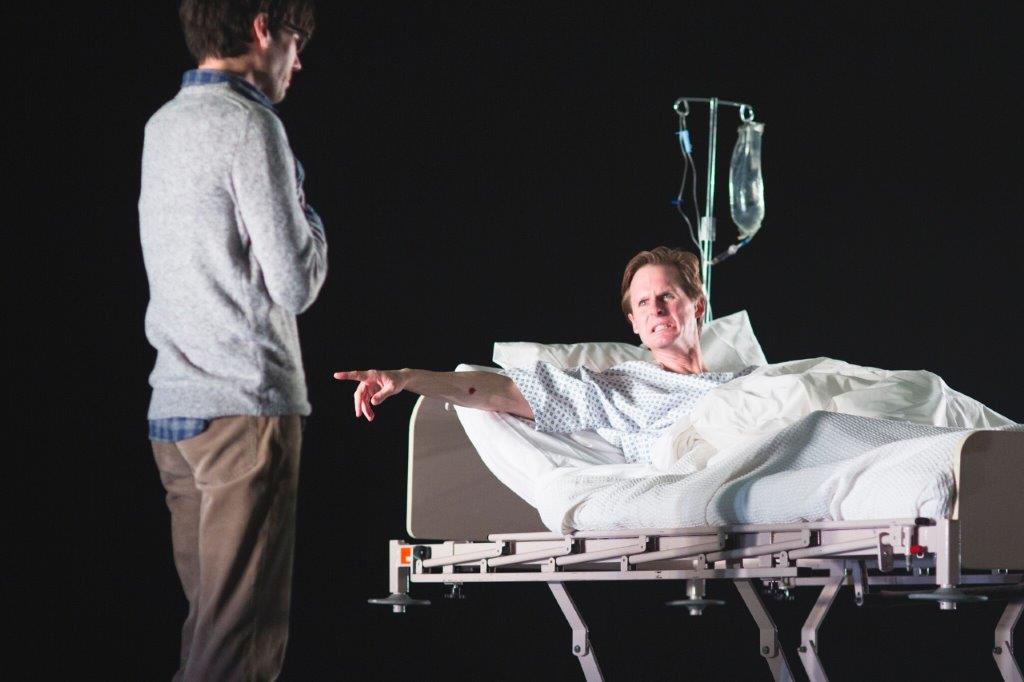
The set takes full advantage of the technical wizardry available at the Heath Ledger Theatre. Director Kate Cherry and Set Designer Christina Smith have wisely gone for a minimalist look with settings represented only by a key piece of furniture – Ray Cohn’s desk, a wash basin, a settee, a hospital bed etc that all effortlessly glide into place. The transitions are slick and the focus is on the performances and Kushner’s prose that is, at turns, poetic, cruel, dagger sharp or slyly funny. And make no mistake there is great humour to be found here amongst the emotional tumult. The climactic ending summons the full arsenal of lighting, sound, costuming, and set design as the world literally falls in on Prior.

The standout performance of the first half belongs to Jo Morris who plays Harper, a woman struggling to deal with her own demons including fear of climate change and the strange noises coming from the bedroom. Reliant on Valium, Harper conjures imaginary friends and hallucinations with a self-awareness that is funny but laced with poignancy. Morris displays wonderful comic timing especially in the hallucination sequences which she tackles with relish. But the irrational fears and reliance on pills are given harrowing treatment as well. The second half suffers a little from her lessened presence except for the bravura Antarctica sequence that is a highlight for Morris.

The other standouts are Adam Booth as Prior who gives an emotionally truthful performance as a man not only dying from AIDS but devastated at Louis’ withdrawal; and O’Mahony as Louis who has a complex arc as he seeks solace in his ‘betrayal’ by engaging in acts of cold, random sex while striking up an unlikely friendship with Harper’s husband Joseph Porter Pitt (Stuart Halusz). Joe has denied his sexuality until finally confessing he is a homosexual over the phone to his mother in an all too real awkward moment of self-loathing and revelation. Prior and Louis coming to terms with their relationship and Prior’s imminent death is the backbone of the second half with Booth and O'Mahony compelling.

John Stanton plays the loathsome lawyer and power broker Ray Cohn with expletive laden relish but it’s in the quieter moments where he excels – the scene with Joe at a bar and his confrontation with a ghost from the past are memorable. The rationalisation Cohn gives on learning of his medical condition is delivered with chilling pragmatism by Stanton – status and power are the only language the character understands and deals in. Halusz in many ways has the trickiest role as his Joe is an earnest character who denies his true self and remains principled in the face of Cohn’s temptations and his wife’s descent into fantasy. He plays the Mormon lawyer with a straight forwardness that works in contrast to the showier roles around him and acts as a foundation of sorts for the audience.

The only weakness is Kenneth Ransom’s dual roles of Harper’s imaginary friend Mr Lies and the gay drag queen Belize. The latter simply isn’t flamboyant enough and the former lacks any flair. Both are opportunities to ‘go large’ but ended up being flat portrayals barely differentiated from each other. Felicity Mckay and Toni Scanlon round out the cast with Scanlon especially engaging as the Rabbi.

I enjoyed the superb first half more than the second which had some odd scenes that seemed somewhat extraneous (largely revolving around Joe’s mother coming to New York) or verging into Pythonesque territory (Prior’s ancestors visiting his sick bed). Otherwise this was an excellent production that showcased Black Swan’s considerable technical and performance capabilities.

Written by Tony Kushner, Directed by Kate Cherry and starring Adam Booth, Stuart Halusz, Felicity Mckay, Jo Morris, Will O’Mahony, Kenneth Ransom, Toni Scanlon, and John Stanton, Angels in America, Part One is on at the Heath Ledger Theatre until 19 June.   

*photos by Daniel James Grant

Thursday, 12 November 2015

Next to Normal - Black Swan State Theatre Company (10 November 2015)

2015 is proving to be quite the stellar year for musical theatre in Perth. One of the reasons is productions that tackle subject matters and themes you wouldn't immediately associate with the genre - shows such as Urinetown (pungent dystopian satire), Spring Awakening (repressed teenage sexuality), Assassins (killing US presidents!) - and now a rock musical about bipolar disorder and its effects on a family. I attended the third and final preview.

Next to Normal stands out for the fact that its subject matter is challenging and under-serviced, certainly in musical theatre form. It demands that the acting from the performers is as good, if not better, than the singing requirements. The cast here deliver in spades with a potent mix of excellent songs, a great score, and a fully formed narrative arc for its central character that is as harrowing as it is gut wrenching. It is clear why this is one of only a few musicals to have won a Pulitzer Prize for Drama.

Horwood, Alyce, Beck & Cormick
Gary Marsh Photography
That lead character is Diana Goodman; wife, mother, and a woman struggling to cope with bipolar disorder. Rachael Beck is superb as Diana bringing impressive acting chops and a wonderfully clear and expressive singing voice to the table. It's a role that necessitates incredible highs and devastating lows and Beck embraces that range with skill, nuance, and incredible stage presence. You simply can't take your eyes off her - she is at the centre of everything - and Beck elicits such a strong emotional response from the audience. The songs deepen our understanding of that emotional landscape and are delivered in style, whether plaintive and heartbreaking; playfully raunchy; or full on angst. There is also humour and hope to be found here and it's well calibrated in that regard.

Medical treatment for bipolar comes under the microscope as the suburban housewife is forced to suffer varying forms of medication and procedures that take away her fundamental essence; her sense of who she is, good and bad. It also fails to address the possible underlying cause of her mental state as some memories cannot be erased by modern medicine no matter how invasive and powerful. You can only feel but empathy for the character as the writing and Beck's performance is first rate.

Diana's condition impacts those closest to her - husband Dan (Brendan Hanson), daughter Natalie (Shannen Alyce), and son Gabe (James Bell). Natalie has a new boyfriend, the stoner Henry (Joel Horwood), while Diana is being treated by Drs. Madden and Fine (both played by Michael Cormick). A total cast of only six and what a cast it is. Acting and vocal talent across the board is exceptional with everyone given their moment to shine.

Hanson has perhaps the most difficult role - Dan is described by Diana as stolid, steadfast, solid and stoic. In the early going his was the one character in danger of verging into caricature. But as the show progressed and Dan is forced to make increasingly difficult decisions regarding his wife that smoothed itself out until Hanson delivers a devastating punctuation point (I Am the One - Reprise) in the aftermath of Diana's final choice.

Shannen Alyce & Joel Horwood
Gary Marsh Photography
One of the highlights was seeing 2014 WAAPA graduates Alyce and Horwood in their first Black Swan production. They worked so well together (Perfect For You, Hey #1-3) and sang beautifully. Horwood gave Henry a sweet naivety and charm while showcasing an excellent voice. Alyce played the studious daughter who rebels in the face of the family issues aided by Henry's more carefree influence with a believable forthrightness that was compelling. There is a moment when she is onstage with Beck performing Everything where you see the consummate present and the bright future side by side that had me grinning in appreciation.

Cormick is memorable as especially Dr. Madden when Diana's fantasies are occasionally brought to life with a shot of rock 'n' roll style voltage. He has a powerful voice and an authoritative stage presence that matches Beck blow for blow as they duel both in acting sequences and numbers such as Didn't I See This Movie? with ECT looming.

The other standout for me though was James Bell as Gabe. It's the relationship between Diana and Gabe that is the heartbeat of this piece and Bell is simply electrifying. Gabe's presence carries so much emotional heft and Bell attacks the role with such energy that his impact is undeniable. Another tremendous vocal talent, his performance and its ramifications are pivotal to making this fly.

There IS an orchestra pit! Gary Marsh Photography
Another aspect, of course, is the music and I was curious to see how this would work in the Heath Ledger Theatre. I now know that there is in fact an orchestra pit and the sound balance and quality was excellent. The six piece band under Musical Director David Young (also on Keyboards) played very well. The show took off in a sequence of songs where it all clicked as a rock musical - I Am the One, Superboy and the Invisible Girl, Open Your Eyes and I'm Alive. It felt like a clear change of gears as the energy level ramped up but more than that I suddenly discovered 'the voice' of the piece. From then on I was all in.

Musical highlights abound but special mention to I Dreamed A Dance and How Could I Ever Forget?, two stunning sequences that fuse lyrics, music, direction and performance for maximum emotional impact. Only one criticism - given the quality of the songs it was disappointing they were not listed in the programme; an all too often and baffling omission for musicals.

Hanson, Bell, Horwood, Beck & Alyce
Gary Marsh Photography
Wisely, given the more intimate nature of the show, Set Designer Bruce McKinven halved the depth of the spacious stage space with curtains forming a 'back wall' for most of the production. There was a central revolve with an outer rim that rotated independently as well which director Adam Mitchell used to great effect. The main piece of set on the central revolve was a large wood-panelled block where the panels opened on each side to depict everything from kitchen sink to toilet to bathroom vanity.

Scene transitions were slick as the revolves ensured the pace never flagged. Lighting design by Trent Suidgeest was evocative and well judged while the sound design by Ben Collins was the best I've heard at this venue; the only minor quibble being that Hanson's microphone volume was noticeably lower in the early scenes but this was soon corrected.

This is an excellent production with everybody at the top of their game, on stage, in the orchestra pit and behind the scenes. Directed by Adam Mitchell with Music by Tom Kitt, Book and Lyrics by Brian Yorkey, Musical Direction by David Young and starring Shannen Alyce, Rachael Beck, James Bell, Michael Cormick, Brendan Hanson and Joel Horwood; with Young on Keyboards, Michael Perkins (Drums/Percussion), Shane Pooley (Bass), Andrew Weir (Guitar), Brian Kruger (Violin) and Laura McGorgan (Cello), Next to Normal is a must see and is on at the State Theatre Centre until 22 November.

Tuesday, 22 September 2015

Extinction - Black Swan State Theatre Company (21 September 2015)

The head of a mining company (Matt Dyktynski) hits a rare tiger quoll on a country road near where he grew up. Understanding the magnitude of the tragedy – the tiger quoll hasn’t been spotted in over a decade – he takes the injured animal to the vet where he initially meets a young zoologist (Hannah Day) and eventually her partner, the vet himself (Myles Pollard). So starts his quest to save the species using $2 million of his company’s mining profits to convince the vet’s sister, the academic head of a research institute (Sarah McNeill), to assist. The dilemma is obvious – big business versus the environment writ large in the academic’s compromised position. There are various romantic entanglements along the way and a subplot involving one of the character’s own physical demise.

Such is the story at the second preview of this world premiere Hannie Rayson play.

Let me say first up that I thought the cast was very good. Hannah Day was excellent as the spunky American zoologist who is idealistic, compassionate and motivated by her love of animals and the environment. Dyktynski gave the mining head a larrikin, knockabout sort of quality that was engaging and provided most of the sporadic humour. Pollard is such a strong physical presence that it’s interesting when his character’s body betrays him, bringing an anger and rage that was believable. McNeill gives the somewhat uptight and vaguely superior academic a few wrinkles of self-doubt mainly to do with her own personal situation.

It’s a pity then that the material doesn’t give them much to work with. Everyone talks in exposition – within a couple of minutes of meeting the mining head and zoologist are exchanging detailed aspects of their backstories – and when they’re not doing that they are merely archetypes for arguments about the environment versus big business. It made it difficult to have any emotional connection with any of the characters as they spewed forth facts, figures, positions, arguments and detailed personal resumes.

Sarah McNeill & Hannah Day. Picture by Gary Marsh Photography
The most egregious example of this was early in the second act when brother and sister are arguing about her decision to take the ‘dirty money’ to help save the quolls. During this the brother drops a box because he is physically incapable of holding it. She continues the argument with not even a pause as we witness the first serious sign of his decline. I was gobsmacked. It’s your brother! No reaction. No response. Nothing!

Later the scene changes so that he verbally assaults her for not understanding his condition and fearful of her pity. Putting aside the fact he clutches at his sister with enough strength to hurt her whereas moments before he could barely hold anything, this actually showed a moment of real conflict and rage on his part. He tells his sister that her decision to take the mining money is what will end their relationship and that he will oppose her at every turn. If only this had been much earlier and actually formed the spine of the narrative.

Instead we get a series of increasingly convoluted relationship dilemmas that felt forced to service an underwhelming climax. One decision by the mining head, in particular, struck me as quite inexplicable given what had come before and led to a long scene between himself and the academic that belonged to another play. It, however, was a necessary plot point for where the play ends up. Which is some tonally jarring shtick as the relationship dilemmas turn into farce and all is saved by an unlikely antagonist and some IT magic I was struggling to find credible.

While the sound design was excellent with the aural representation of the bush and its inhabitants nicely rendered, the set itself was a major disappointment. Perhaps I have been spoilt by some truly wonderful sets at previous Black Swan productions like Laughter on the 23rd Floor, the real estate office from Glengarry Glen Ross, and especially Blithe Spirit but this was sparse to say the least. It is a very big space with a small cast so the bunker style approach with lots of scrims and back projections and minimal trappings was bleak indeed.

Hannah Day & Matt Dyktynski. Picture by Gary Marsh Photography
The only time the set impressed was at the start of the second act when we are in the bush and the representation was wonderfully done. The technical feat of dismantling that brief mirage and re-establishing the bunker was fascinating but quickly plummeted me back into monolithic gloom.

The play clocked in at well over two hours and with the lack of a clear through line or rising stakes it felt overly long and flat. Plot machinations come late and feel contrived after putting so many balls in the air early. Yes, there are some interesting arguments presented and the mining position is given fair representation but this felt more debate than drama. It was a strong debut by Day in her first Black Swan production, however, the script needed a lot more punch to make this engaging.

Written by Hannie Rayson, Directed by Stuart Halusz, and starring Hannah Day, Matt Dyktynski, Sarah McNeill and Myles Pollard, Extinction opens on Wednesday night and plays until 4 October at the Heath Ledger Theatre.

Tuesday, 21 July 2015

Blithe Spirit - Black Swan State Theatre Company (20 July 2015)

There was ectoplasmic presence a plenty at the second preview of Noel Coward’s astral comedy Blithe Spirit. Director Jeffrey Jay Fowler promised us a once in a lifetime experience as he peeked out from behind the sumptuous red curtain to inform us that Madame Arcati as played by Roz Hammond had been struck ill. He was proven correct in many ways. Alison van Reeken after only one read through of the script and one rehearsal all but stole the show giving a wonderfully physical performance as the clairvoyant even with script in hand.

Normally those three words – script in hand – send a shudder down the spine but here it was as impressive a feat of acting as you’ll see given the circumstances. Afterwards Fowler admitted it was quite a different interpretation of the character but for me it gave the show a jolt of unpredictability as the other actors reacted to van Reeken’s spontaneous and oft hilarious antics.

The set was superbly appointed with the Condomine home well represented with portraits, period furniture, gramophone, and large French doors, stage left. It also revealed some cleverly executed secrets later in the play to great effect. At first though the cavernous space posed somewhat of a problem with plenty of echo and a lot of the opening dialogue faint and a little indistinct. The projection improved certainly with the introduction of van Reeken and Michael Loney (Dr. Bradman) but eventually across the board as all the actors warmed to the task.

It was a bit of a tentative start but the play really found a rhythm in the scene between Charles (Adam Booth) and Ruth Condomine (Adriane Daff) the morning after the séance that summons Charles’ dead first wife Elvira (Jo Morris). The rat-a-tat-tat dialogue as the two exchange arch comments based on Ruth’s misunderstanding of her husband’s retorts to the ghostly Elvira ups the energy and pacing dramatically. There is a similar exchange in the second half between Charles and Elvira that equally pops and fizzes with wonderfully written and delivered verbal venom and dexterity.
Booth, Hetherington & Daff - Gary Marsh Photography

Booth was very good as the writer who initially is only interested in researching jargon for his latest novel, never inclined to believe Madame Arcati’s talents. His arc from disbelief to concern about his mental state on seeing Elvira to embracing and then enjoying the fun and games of the situation to finally exasperation and alarm was well calibrated. Morris plays Elvira with an almost childish glee and impetuousness as she beguiles Charles and infuriates Ruth. Dressed entirely in white with deathly pale makeup and powdered white hair she is a restless spirit as she glides around the stage barefoot.

Daff’s Ruth was very formal, rigid and quite glacial and she was at her best when allowing the character’s urbane façade to slip as frustration and bitchiness emerged. It was a performance that only became stronger the longer the play went. Ella Hetherington (Edith) committed to her character’s running gag that was quite literally a running gag until the maid takes on much greater significance in the second half. Loney and Michelle Fornasier (Mrs. Bradman) lent good support with their own running gag over the doctor’s reluctant refusal of various nightcaps.

Fornasier, Booth, Daff & Loney -
Gary Marsh Photography
The lighting design by Jon Buswell, especially in representing different times of day, was very good and Ash Gibson Greig provided fun and creepy musical interludes as the curtains were closed as the stage was reset between scenes.

It is quite a long play and the second half was much tighter than the first but that should shake out over the run and as van Reeken is integrated into the cast after a hugely impressive last minute debut. 

Written by Noel Coward and Directed by Jeffrey Jay Fowler, Blithe Spirit stars Adam Booth, Adriane Daff, Michelle Fornasier, Alison Van Reeken, Ella Hetherington, Michael Loney and Jo Morris and is on at the Heath Ledger Theatre until 9 August.  

Thursday, 28 May 2015

Glengarry Glen Ross - Black Swan State Theatre Company (26 May 2015)

I’ll say one thing about Black Swan they sure do create wonderful sets for their productions. This one on a Revolve had a restaurant configuration with multiple booths on one side and a real estate office on the other. The level of detail was excellent, especially the freshly burgled office of the second act. Curiously though, unless my eyes deceived me, there was no Board which is referred to several times and the means by which the characters ‘keep score’ in the dog eat dog world of real estate sales. It’s an odd oversight.

The other aspect that undercut the stage presentation was the use of incidental sound – firstly with some cheesy, piped oriental stylings under the restaurant scenes; and with a car horn soundscape in the second act clearly on a loop. The former was particularly distracting. This is David Mamet who is famous above all for his dialogue. Why water it down with such a superfluous element?

To the performances in the third and final preview and this really was a mixed bag for me. The play starts with pairings in the booths – Shelley Levene (Peter Rowsthorn) and the office manager (Will O’Mahony) in one scene; followed by Dave Moss (Kenneth Ransom) and George Arronow (Luke Hewitt); then Ricky Roma (Damian Walshe-Howling) and Steve Turner’s timid prospect James Lingk. Competition is fierce and only those on top of the board will get the premium Glengarry leads. Roma is top dog; Levene is past his used by date but desperate to capture former glories; and Moss cajoles George into contemplating more drastic measures to avoid being fired.

I found Rowsthorn far too over the top both in exaggerated mannerisms and acting style to have any sympathy for Levene. His performance immediately kept me at arm’s length from the whole endeavour which was unfortunate. He starts at such a high pitch that there’s nowhere for him to go. Ransom struggled early in his opening scene but was helped out of a hole by Luke Hewitt who struck me as someone who would have done Levene far more justice. His simpleminded George was well pitched for mine.

Walshe-Howling fared quite well as the smooth talking and cocky Roma but the whole thing only found a rhythm deep into the production in two sequences - when Turner’s customer arrives in the office to withdraw his buy order; and O’Mahony’s retort to Levene’s admonishment after his intervention cruels Roma’s sale.

In stark contrast to the maelstrom of flailing limbs and overly gleeful swearing, Turner’s stillness as Lingk clutches a valise to his chest and quietly conveys his wife’s wishes is a welcome contrast and Walshe-Howling modulates his performance accordingly. It’s a quieter moment that facilitated an interesting scene whereas everything before felt overdone and too much of a caricature for all involved. It also allows for a build to the infamous Ricky Roma tirade instead of the whole play being pitched at the same heightened level. Likewise for O’Mahony who is dressed down by Levene only to push back with the reveal around which the story ultimately pivots. Again, it’s a far more considered moment.

This is only sporadically funny with Hewitt’s George really being the lynchpin to genuine laughs in his reaction to Ransom’s overplayed Moss. The character portrayed by Ben Mortley really doesn’t have much to do and I found him strangely passive in the face of Roma’s arrogance given his rank as a Detective.

Overall I was disappointed by Glengarry Glen Ross – yes, they’re supposed to be larger than life characters in what is described as a ‘vicious comedy’ but I was longing for some, indeed any, nuance to really let this fly.

The play is directed by Kate Cherry and is on at the Heath Ledger Theatre until 14 June.

Sunday, 15 March 2015

Dinner - Black Swan State Theatre Company (14 March 2015)

Saturday night was the first preview of the Moira Buffini black comedy Dinner starring Rebecca Davis, Stuart Halusz, Greg McNeill, Kenneth Ransom, Steve Turner, Alison Van Reeken and Tasma Walton and directed by Kate Cherry. It is the tale of the dinner party from hell as hostess Paige (Walton) celebrates the successful release of her husband’s self-help book with a few select friends.

It quickly turns out that Paige and her spouse Lars (Steve Turner) aren’t exactly the happiest of couples as they await the arrival of artist Wynne (Van Reeken) and her politician beau Bob (a no show due to a breakup prompted by an unfortunate Wynne portrait); and Sian (Davis), the jaded “sexpot” newsreader, and her older husband, microbiologist Hal (McNeill) on a foggy English evening. An imposing waiter (Ransom), especially hired for the evening, has explicit instructions as he silently goes about his work. Paige is put out by Wynne’s solo arrival as everything has been carefully planned. A further spanner is thrown into the works when Mike (Halusz) turns up asking to use a telephone after having an accident due to the fog. 

What follows is a bout of verbal sparring as the bitchy Paige serves increasingly ridiculous dishes seemingly designed to humiliate her guests and husband. Mike’s arrival adds a new dynamic as his real purpose for being there is revealed and he is decidedly not of the usual ilk these people would associate with. A further trial is introduced as Paige insists on a game to be played whereby she asks each person in turn to spend two minutes talking to a subject she has placed in separate envelopes. It all ends in tragedy as twists and revelations come to the fore.  

While the plot is really no more than an excuse to put various character types in close proximity and watch them dangle, there are some genuinely funny moments here. Walton, resplendent in a figure hugging designer gown, is all tightly wound vitriol as she prods and torments and abuses all and sundry. Davis, elegant and leggy in another designer dress, is blunt and aloof as Sian amusingly speaks her mind without any kind of filter or care for others’ judgements. Turner gives Lars a certain self-satisfied smugness with all the self-help mumbo-jumbo a counterpoint to Paige’s venom. He portrays the husband’s increasing annoyance and frustration with her more as a slow fuse than outright explosion.

Van Reeken’s Wynne who is in love with Lars is the sort of new age, vegetarian, earth mother artist who despises the C word (which gets quite the work out) that would rile any dinner guest after a while. McNeill’s Hal is accomplished but unhappy even with a new trophy wife. Paige’s attacks on him, particularly in reference to his first wife and love of his life, are most cruel. Then there’s Mike who is a necessary wildcard to proceedings and a catalyst for further mischief. Halusz initially plays him as the straightforward working class man who has stumbled into something out of his usual reckoning but slowly becomes cockier as he takes stock of who he’s up against. That he forms an alliance of sorts with Paige is most subversive. 

The dinner table is set on a revolving platform that is always in motion as the meals are served which allows us to see all of the actors’ expressions and reactions as scenes progress. The table itself and chairs are see-through plastic to help with visibility in what otherwise could have been a static and visually awkward presentation. I especially liked the use of smoke effects to depict the fog whenever the outside door was opened as various characters escaped for a breather or to liberate misfortunate crustaceans. Indeed the ‘live lobsters’ were a fascinatingly dark comic moment.

There were points the pace flagged – notably when the two minute discussions switched to Lars and Wynne’s back story. Other characters became mere spectators especially the up-to-that-point talkative Mike so it felt a little artificial and also a curious sequence in that it seemed to favour Lars instead of belittle him. Given the ending (which, for mine, was telegraphed anyway), I also didn’t quite understand what Paige’s real intentions were in the various ‘movements’ of the dinner. The Mike character ultimately felt like a device as the writing seemed to vacillate about who and what he really was depending on the situation.

However, if you like your comedy jet black and your insults like a dagger to the heart you’ll enjoy Dinner with its absurdist culinary delights and vitriolic dialogue. There are two more previews on Monday and Tuesday with the show opening on Wednesday 18th March and running until 29 March.

Sunday, 26 October 2014

Gasp! - Black Swan State Theatre Company & Queensland Theatre Company (25 October 2014)

Excited chatter went around the Heath Ledger Theatre as people realised that Ben Elton was in the audience for the opening preview of his play Gasp! The director Wesley Enoch gave a brief introduction including the right to stop the play at any stage if there were technical difficulties. Thankfully this wasn’t required as the performance went smoothly with opening night scheduled for this Wednesday.

Gasp! is a reworking of Elton’s first professional play (originally called Gasping) and has been reimagined specifically in an Australian context. It is a satire about the absurdity and ethical vacuum of big business as even air is commodified for profit. Great for those who can afford this designer air, not so good for the poor who slowly suffocate. 

The cast is made up of Greg McNeill as Chifley Lockheart, head of a resources company that has mined most of Australia and sent it offshore to the Chinese. Steven Rooke plays a seven figure executive, Sandy, who toadies up to the boss at every opportunity and lords over the six figure number two, Phillip (Damon Lockwood). Phillip has his heart set on asthma-ridden Peggy (Lucy Goleby) whose respiratory ailments give him the idea for Suck ‘n’ Blow, a device that sucks in the air, purifies it, and blows it back into classy establishments. But as Caroline Brazier’s high powered marketing executive, Kirsten, excels in selling this designer air, suddenly consumers are hording it until finally oxygen itself is just another product. The power of global market forces ensures it quickly becomes out of reach of the masses to devastating consequences.

The cast is excellent. Lockwood impresses as the man who wants to prove himself not only in the company but to the girl he tried to kiss ‘on the oval’. I have some issues about his character’s arc but this is otherwise a very engaging performance. McNeill has great fun as the blustering corporate heavyweight and gives a cheeky turn in more ways than one. Rooke has a difficult role as his character is largely a device to generate conflict and obstacles for Phillip but he does it well. Brazier gives the ballsy ad executive an air of supreme confidence and sexiness that works in direct contrast to perhaps the key role, Goleby’s Peggy. She plays the moral compass of the play with a natural charm that grounds proceedings as every other character deals in hyperbole and one-upmanship.  

Enoch’s curious introductory remarks make much more sense when you see the technical ingenuity of the set where sliding sections of stage floor meant scene changes were quick, seamless, and inventive. There is also a large screen on the back wall where images and charts are projected to give this a real visual flair. The recreation of an executive steam room was particularly well done. There was only one moment where Lockwood was left in darkness at the beginning of a scene a few beats too long but being most adept at improvisation his winking nods to the audience kept things moving nicely. There were some minor timing issues but that will shake out over the run as the cast adjusts to where unexpected or prolonged laughs and spontaneous bursts of applause land.

Then there is the writing. Blackadder certainly was a formative sitcom as I was growing up and that style of humour is replete here, especially throughout the first act. Witty and cutting asides on topics and persons of derision are trademarks but at times it felt like Elton was too eager to please a hometown audience. The local references are fast and furious and there is an immediacy that instantly dates this version. The mining industry and figures such as Gina Rinehart, Clive Palmer, Twiggy Forrest and Rupert Murdoch are easy targets as is the obligatory Abbott jab. Then there’s a host of pop culture references including the Kardashians, the Minogues, and even a Russell Crowe gag. Sure, it’s funny but at times felt strained.

Enoch had also mentioned that the creative team would be watching audience reactions as they calibrated the show and performances. This becomes notable in the second act where there was an early sequence where the humour became questionable especially in relation to women and there was an outburst regarding indigenous Australians that had me gasping but for all the wrong reasons. It was in keeping with the character’s viewpoint but the fact it went unchallenged was a concern. The mood of the audience noticeably shifted and it was an uncomfortable stretch for a while.

The second act is problematic because the dilemma set up for Phillip is whether he’ll stay beholden to the company or follow his conscience as pricked by Peggy. At times he seems to resist the manipulations of Lockheart but then is complicit in the larger horror of the ruthless extension of the air industry. So Phillip’s moral compass wavers all over the place whereas it called for a more natural progression. Peggy’s fate is dealt with in perfunctory fashion which felt odd as she should have been the moral bedrock in any decision Phillip made. The ending acts only as that – an end to the play. It comes out of left field and is thematically disturbing – the only action to take in the face of a rapacious and out-of-control business conglomerate is one so extreme as to be horrifying on many levels. Yes, this is satire but it was too much of a dark twist for mine. In the words of the play, it needed another ‘dog turd’ to bring out the absurdity in the fabric of the premise.

Having said that, there is a lot to like here - very strong performances, a great set and, especially in the first half, the trademark sense of humour that has made Ben Elton a household name. However, it will be interesting to discover whether Messrs’ Enoch, Elton and co were indeed listening to the mood of the audience early in the second act as the lady sitting next to me openly pondered as the lights came up.

Gasp! opens on Wednesday night at the State Theatre Centre and runs until 9 November. Written by Ben Elton and Directed by Wesley Enoch it stars Damon Lockwood, Greg McNeill, Caroline Brazier, Lucy Goleby and Steven Rooke.

Sunday, 14 September 2014

Laughter on the 23rd Floor - Black Swan State Theatre Company (13 September 2014)

Hot on the heels of Greg Fleet’s auspicious playwriting debut at The Blue Room, another well-known comedian features in a play, this time Neil Simon’s Laughter on the 23rd Floor. 

In this, Peter Rowsthorn, he of the rubbery contortions, plays the titular star of 50’s television smash, The Max Prince Show. Staged at the Heath Ledger Theatre by Black Swan this is a funny play indeed. Yet Rowsthorn doesn’t dominate in a measured performance where he is surrounded by an excellent supporting cast.

There are plenty of laughs to go around which is appropriate as the play is set in the writing room of said show. Given that the legendary Simon worked in television at the beginning of his career, part of the joy is in spotting the famous people who have inspired this roster of writers. Max Prince himself is based on Sid Caesar and Ira Stone is more than channeling Mel Brooks, for example.

Beneath the one-liners, the wordplay and bouts of physical comedy, there is an undertow of serious subject matters on Simon’s mind. Senator McCarthy’s tentacles are felt as the fear of being Blacklisted is ever present; and there is not-so-subtle commentary about the dumbing down of television as the network demands more ‘shit’ so they can sell more ‘shit’. Both of these threats present the characters with the dilemma of self-censorship, acquiescence, possible unemployment or even worse with McCarthyism running amok. What then the responsibility of the writer to stand up to the perversion of democratic process and rights? As Russian-American Val Skolsky (Igor Sas) states, first they go after the politicians then they go after the writers.

Predominantly though this is a witty exploration of a group of quirky characters who, let’s face it, do a pretty quirky job – making people laugh. Humphrey Bower plays the colourful Milt Fields who dresses in style to be ‘somebody’. Bower is very convincing and contributes many droll asides as we discover how competitive this room is. Sas is a standout as Skolsky, all angst and anguish with a thick Russian accent that was never hard to follow. James Sweeny, the cipher for Simon himself as Lucas Brinkman, is all fresh-faced earnestness and our narrator. He plays the shy, sweet newcomer well and is a nice counterpoint to the more cynical veterans of the writing staff.

Stuart Halusz is the voice of reason as Kenny Franks and it’s interesting watching the dynamics of the group as they all vie for Max’s attention and, more importantly, get their lines in the show. Damon Lockwood arrives late in the first act but then his character, the hypochondriac Ira Stone, is always late. Lockwood gives a funny performance as the whining, anxiety-crippled Stone who is certain of his pre-eminence as the best writer. Jo Morris plays the only female writer on staff, Carol Wyman, and she does so with spunk and intelligence. It’s telling when Wyman demands to be treated and regarded as a good writer not merely a female writer given the cutthroat nature of the business, especially when one member of the staff has to be let go.

Ben Mortley sports an Irish accent as Brian Doyle who is always signing a deal to go to Hollywood with his latest screenplay. His character has a prickly relationship with Stone which gives Mortley licence to land some verbal jabs as one of the blunter characters. Lara Schwerdt is the secretary Helen who is competent officiousness but, perhaps unfortunately, is played for laughs as an aspiring comedy writer herself late in proceedings. That she comes across as ditzy here undercuts the stance taken with Carol.

Then there is Mister Rowsthorn himself. He is good as Max Prince – paranoid the network is out to get him, forgetful, occasionally lost in a daze of pills, impulsive, good-natured and ultimately protective of his troops even though there are moments of spite. There is a memorable sequence as he plays Julius Caesar (in a sketch they are writing) where Rowsthorn gives full rein to his signature brand of physical humour but other than some wall punching he is quite restrained which makes this truly an ensemble piece.

The set is astonishingly good with the New York skyline as the backdrop through large windows and the writers’ room beautifully furnished and appointed. The final scene is so beautifully lit with the inclusion of a surprise prop that looked wonderful as snow falls ‘outside’ that I almost forgave the play lingering a little long and ending on too sentimental a note. Otherwise, this is tremendous entertainment with snappy writing and a great cast working on a wonderful set.

Directed by Kate Cherry, Written by Neil Simon and starring Humphrey Bower, Stuart Halusz, Damon Lockwood, Jo Morris, Ben Mortley, Peter Rowsthorn, Igor Sas, Lara Schwerdt and James Sweeny, Laughter on the 23rd Floor is on at the Heath Ledger Theatre until 21 September.